Epitomising the Epitome: A new manuscript of the History of Agapius
Agapius (Maḥbūb) son of Constantine of Mabbug is a Christian Arab who came to be known only through his Syro-Arabic work, Kitāb al-Tārīkh, The Book of History (written in 942 CE). This book provided us with information about the provenance of the author, his time, his denomination, his ethnicity, and his intellectual output. It also helped us delineate the developing epistemology of late antiquity through its engagement with predecessors and successors on the ladder of historical knowledge of the past. The importance of this link may become apparent when we know that one primary predecessor was Theophilus of Edessa (d. 785), who occupied part of great import of the ladder, living at the heart of late antiquity and passing on the torch of antiquity.
Our knowledge of the work of Agapius and its composer was based largely on solid ground, while some of it needed refinement in accordance with new studies. Such refinement, however, was destined to occur only late, partially due to the absence of a critical edition of the text. Having long evaded the attention of scholars, the weight of this absence, once dealt with, figured primarily in drawing attention to findings of immense importance to modern scholarship. One such finding led to the recognition of two key conclusions: that the work of Agapius is an epitome, and that the work epitomised by him was none other than the long presumed lost Chronicle of Theophilus.[1]
Epitomising the Epitome
That Agapius made an epitome of another work should have been no surprise, since he himself says that he did so in regard to books of Theophilus. Nevertheless, the passage in which he made this statement has remained a subject of obscurity and doubt. The fact that he summarised a work of Theophilus, therefore, was granted, but it is the extent to which he made this summary what should come, in view of the common belief heretofore, as a great surprise – it is an epitome of the entire Chronicle of Theophilus and not merely a small part of its narrative. Despite the reflection of this epitomising process on the originality of the work of Agapius, it is regrettable to us only inasmuch as it did not convey to us more of the work it aimed to summarise.
As time has revealed to us recently, this epitomising process is in turn mirrored in the work of Agapius himself, and the regret that emerged due to his abstinence from transmitting the Syriac Chronicle more substantially is extended to this recently discovered epitome of his own work.
A New Manuscript
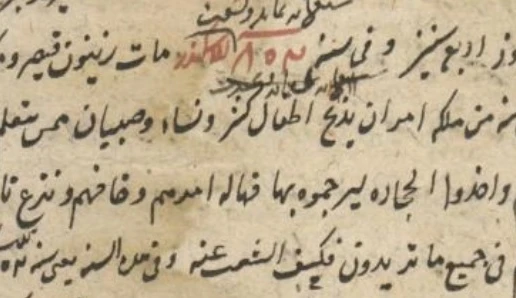
In 1897, Wilhelm Ahlwardt (d. 1909) published the ninth part of his catalogue of the Arabic manuscripts in the Berlin State Library. In this part, we find manuscript number 127 of the second collection purchased in 1870 from Julius Petermann (d. 1876) after whom it is named in its shelf mark (Ms. Petermann II 127).[2] In his detailed description of the manuscript, one text contained in it was easily identifiable in the second part of the Copto-Arabic History of al-Makīn Ibn al-‛Amīd (d. probably in 1292-93), which became known in Europe since its publication in 1625 by Thomas Erpenius.[3]
The Geschichtscompendium found in the first part of our manuscript, however, was unknown to Wilhelm, since this compendium belongs to the text of Agapius, published first by Alexander Vasiliev between 1910 and 1915[4] and again by Louis Cheikho in 1912.[5] These two editions notwithstanding, the text has been shown to be in need of a new critical edition. The task of editing this work will be beset by two primary problems. One problem lies with the limited number of available manuscripts of its first part, especially those manuscripts classified in the first recension, which is characterised by primitive readings and is present almost solely in a manuscript residing in the Monastery of Sinai. The other problem, which concerns the second part of the History, is deeper since this part is extant only in a single incomplete, lacunose manuscript, now residing in Biblioteca Medicea Laurenziana (Florence). In addition, some folios of this manuscript were stuck together due to humidity and therefore were illegible to both editors. This problem was solved only when Robert Hoyland paid a visit to its holding library in Florence and published the text of these previously inaccessible folios.[6] The more substantial problem, however, persisted due to the lacunose nature of the manuscript. This difficulty caused considerable trouble to researchers working on this section of the text.
In the recent digitisation of the Berlin manuscript,[7] some consolation has emerged. After long relying only on Wilhelm’s tantalising description, we are now able to assess the import of this compendium. Prefixed by two extracts taken from the second part of the History where Agapius gives two chronologies ascribed to Africanus and Chrysostom, it is an epitome of both parts of the text, made by some learned Muslim redactor who summarised, Islamicised and elaborated on it with the use of other sources (notably the account of Alexander the Great f. 17r-19v). These foreign elements are of interest and worth an investigation into their sources. Yet it is the text type of the two parts of Agapius’ work that are of considerable importance. The first part is based on a primitive recension parallel to the Sinai manuscript, thus making it a helpful witness to this part. The second part, brief as it is, is the second manuscript we behold so far of the second part of Agapius’ text, based on another model of this part, and not on the Florence manuscript. A few examples from this part may serve as illustration.
1. For the time-period from Adam to the Crucifixion, Agapius gives this account:[8]
Ms. 323, f. 6r, Florence |
Ms. Petermann II 127, f. 24v |
فمن ادم الى هذه الغاية خمسة الف وخمسماية وتسع وثلثين سنة كقول هرٯلىىٯس ..... في ذلك فقال كل واحد منهم .... منتها علمه أولهم اوسانيوس فانه يقول ان من ادم..... له المجد خمسة الف...... الف وثلثمايه وخمسين سنة فاما العبرانيون فانهم يقولون انها اربعة الف سنة فقط |
فمن ادم الى هذه الغاية خمسه الاف وخمس ماىه واىنىان وتلتون سنه وقال هرقلس وىوحنا فم الذهب ومن زمن هبوط ادم الى ان رفع عيسى خمسه الاف وخمسماىه وتسع وثلىن سنه وقال ارسانيوس 5232 سنه وقال افرىقىاىوس 5532 سنه وقال ىحىى النحوى 5350 سنه قال العبرانيون 4000 سنه فقط |
From Adam to this point [the total is] 5539 years according to Hrqlyyqs…. on that, so each one of them said….. [to] the extent of his knowledge, the first of whom is Ausonius who said that from Adam….. glory be to him, 5 thousand….. 1350 years. The Hebrews say it is 4000 years only. |
From Adam to this point [the total is] 5532 years. Hrqls and John Chrysostom said that from the descent of Adam until the ascent of Jesus [the total is] 5539 years; Arsenius said [the total is] 5232 years; Africanus said 5532 years; and John the Grammarian said 5350; the Hebrews said 4000 years only. |
In addition, an Islamic element is added by our redactor here in the following text (f. 24v):
“Jesus - peace be upon him - shall descend by the white minaret, east of Damascus, kill the Antichrist, break off the cross, mandate tribute, stay on earth for forty years, then shall be buried with our prophet Muḥammad, may God bless him and all prophets and messengers.”
2. Tracking the timeline in Agapius’ chronicle, in view of successive reigns, the regnal tenure given to each emperor, and the continuous calculation of years according to the Seleucid era, a consistent chronological framework was observed, beset only by two problems. The first of these was the anno graecorum year in which Anastasius I is said to have begun his reign. In the Florence manuscript we read 806 AG. Yet this should have been 802 AG to agree with the preceding and following timeline in Agapius. Here, the Petermann manuscript (f. 33r) reads 802. The second problem is less serious when we consider the readiness of perceiving it, yet a bit complex when considering its attestation also in our manuscript. The sixth millennium, it is said here, completed in the sixth year of Anastasius. In our chronicle, Anastasius reigned in 802 AG. Once this number is added to the Byzantine era of 5197 AM, it becomes clear that the sixth millennium completed in “the second year” of Anastasius, instead of “the sixth”. This common mistake, therefore, may go back to a common model that both manuscripts copied, or to Agapius himself.
3. Upon coming to the Islamic section, we find similar instances. In the account of the Alans raid, Robert could not help but amend the text of the Florence manuscript, placing the raid in the second year of Muʿāwiya instead of the eighth as it stands in the Florence manuscript. In our manuscript (f. 38r), we read that this raid took place in the twenty first year of Constans II, which makes it clear that our redactor read “second” in his model manuscript. Next, we are told that ‘Abd al-Raḥmān b. Khālid raided the Byzantine territories and captivated in their land “سبا... بارض الروم وبلغ المسلمون اقلونية”. This phrase is awkward, however. In the texts of Theophanes (d. 817) and Elias of Nisibis (d. 1046),[9] we are told that ‘Abd al-Raḥmān “wintered” in the land of the Romans. This is what we read also in our manuscript (f. 38v), “شتى...”.
The text stops here with the coronation of Justinian II and concludes with a general chronology from Adam to the beginning of Islam, which is based on that of the second narrative we find in Agapius, probably ultimately taken from Qusṭạ̄ b. Lūqā (early 10th century).
This is followed, in the same folio (f. 39r), by the second part of the History of al-Makīn Ibn al-‛Amīd, which is itself an epitome of an earlier Islamic chronicle. The work of al-Makīn is a peculiar one since its author issued it in two editions. This is clear from the manuscript tradition that has reached us of the first part. The second part, too, gave us the same impression, but only with the help of a single manuscript, now residing in the British Library (Ms. Or.7564). Another manuscript, therefore, was needed to confirm this tentative conviction. With this in mind, this manuscript, which Petermann carried along from the Orient, was consulted, though to no avail. The paragraphs containing the elements unique to the other Oriental manuscript of London are paraphrased or simply dropped out. Thus, this question needs a thorough investigation in order to reach a more solid conclusion.
Conclusion
This recently discovered manuscript of the Berlin State Library shall constitute an important witness to researchers working on both the works of Agapius and al-Makīn. For the text of Agapius, it means that another witness to the primitive recension of his first part is extant. It also means that one more witness of his second part has survived. This part of the manuscript will therefore be most welcome for reconstructing Agapius’ text. It is unfortunate only that, when it comes to the shared contents by the dependents of the Eastern Common Source, we do not find any considerable extract in our manuscript that may help reconstructing the illegible elements in the Florence manuscript. Yet a glimpse of hope arises in regard to the possibility of discovering more manuscripts of the text.
[1] This article is mainly based on M.A. Rashed, The History of Agapius revisited, in Le Muséon, 138, issue 3-4 (2025), p. 381-426, while epitomising and elaborating on it.
[2] W. Ahlwardt, Verzeichniss der arabischen handschriften, vol. 9 (“Die Handschriften-Verzeichnisse der Königlichen Bibliothek zu Berlin,” 21), Berlin: Asher, 1897, p. 49-52.
[3] Th. Erpenius (ed., tr.), Tārīḫ al-Muslimīn / Historia Saracenica, Leiden, I. Maire, Elzevirios, 1625; ʿA.B. Ḥasan (ed.), Tārīḫ al-Makīn: Tārīḫ al-Muslimīn, Cairo, Dār al-ʿAwāṣim, 2010 (both editions offer an incomplete text). The (first volume of the) first part of this work, covering the period from Creation to the rise of Islam, was published in M. Diez (ed., tr.), Al-Makīn Ǧirǧis Ibn al-ʿAmīd: Universal History. The Vulgate Recension. From Adam to the End of the Achaemenids, Leiden, Boston, MA, Brill, (“Arabic Christianity: Texts and Studies,” 6.1), 2023.
[4] A. Vasiliev (ed., tr.), Kitab al-ʿunvan: Histoire universelle, écrite par Agapius (Mahboub) de Menbidj, Turnhout, (“Patrologia Orientalis,” 5.4 (1910), p. 557-692; 11.1 (1915), p. 1-144; 7.4 (1911), p. 457-591; 8.3 (1912), p. 397-550), 1911-1915 [4 fascicles in 2 parts].
[5] L. Cheikho (ed.), Agapius Episcopus Mabbugensis: Historia UniversalisI (“Corpus Scriptorum Christianorum Orientalium,” 65, “Scriptores Arabici,” III, 5), Beirut – Paris, 1912.
[6] R.G. Hoyland, Agapius on the reigns of Mu'awiya and 'Abd al-Malik, electronic publication, https://www.academia.edu/24689...
[7] It can be found here: https://resolver.staatsbibliot...
[8] Vasiliev, Kitab al-ʿunvan: Histoire universelle, Part 2, p. 14 [independent pagination].
[9] C. De Boor (ed.), Theophanis chronographia, 1, Leipzig, 1883, p. 348; E. Brooks (ed.), Eliae metropolitae Nisibeni opus chronologicum (Corpus Scriptorum Christianorum Orientalium, 62; Scriptores Syri, III, 7), Paris, 1910, p. 142.